Auguste Jean
VASE
VASE
Between 1877 and 1884
Blown and hot-worked glass, polychrome enamel decoration, gilt highlights
H. 16 cm; D. 11.5 cm
Cologne - Museum of Applied Arts (Inventory No. F 1463)
© Museum of Applied Arts, Cologne
_
- Collection of Gertrud & Dr. Karl Funke-Kaiser (Cologne).
- In 1986, gifted by Gertrud & Dr. Karl Funke-Kaiser to the Museum of Applied Arts in Cologne.
_
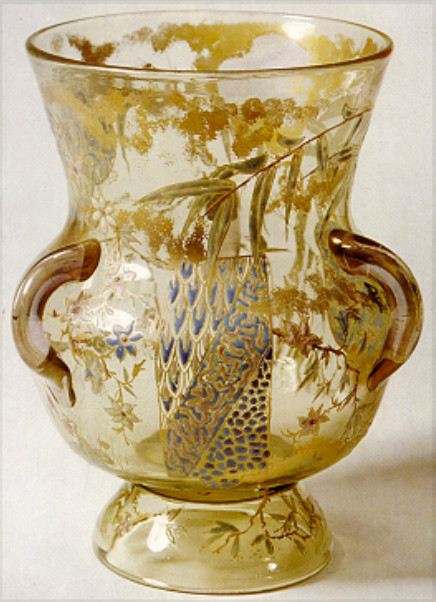
Small vase on a circular foot with a high flared neck, featuring three small handles on the belly, made of translucent smoked glass with polychrome enamel decoration, metallic effects, and gilt highlights. Its silhouette is directly inspired by "mosque lamps" from the Mamluk period, whose forms were widely reinterpreted by 19th-century French glassmakers in the context of the taste for Orientalism. The three small pink translucent glass handles evoke the suspension rings of these lamps.
This Oriental-inspired form is juxtaposed with a decidedly Japonist decoration, covering the entire vase: floral and vegetal motifs, fish, and polylobed cartouches containing geometric compositions inspired by traditional Japanese textiles.
Auguste Jean was not the only glassmaker to be inspired by Mamluk mosque lamps: Émile Gallé and especially Philippe-Joseph Brocard also offered reinterpretations. Unlike Brocard, who sometimes verged on pastiche, Auguste Jean here combines an Oriental form with a Japonist decoration, demonstrating the particularly inventive eclecticism of the 19th century. With its 16 cm height and somewhat squat proportions, the vase deviates even further from historical models. Its rarity is remarkable: only one other vase of comparable form made by Auguste Jean is currently known, but its decoration, this time, is much more directly inspired by the Oriental repertoire.
Condition: Good condition
Signature: Signed on the reverse, under the base: "A Jean."
Partager