Auguste Jean
VASE
VASE
Between 1877 and 1884
Blown and hot-worked glass, polychrome enameled decoration, gilding highlights
H. 15.8 cm
Private collection
© Bonhams
_
Bonhams, Fine Glass, Including the Overduin collection (sale 22021), Lot 89, London, May 21, 2014.
_
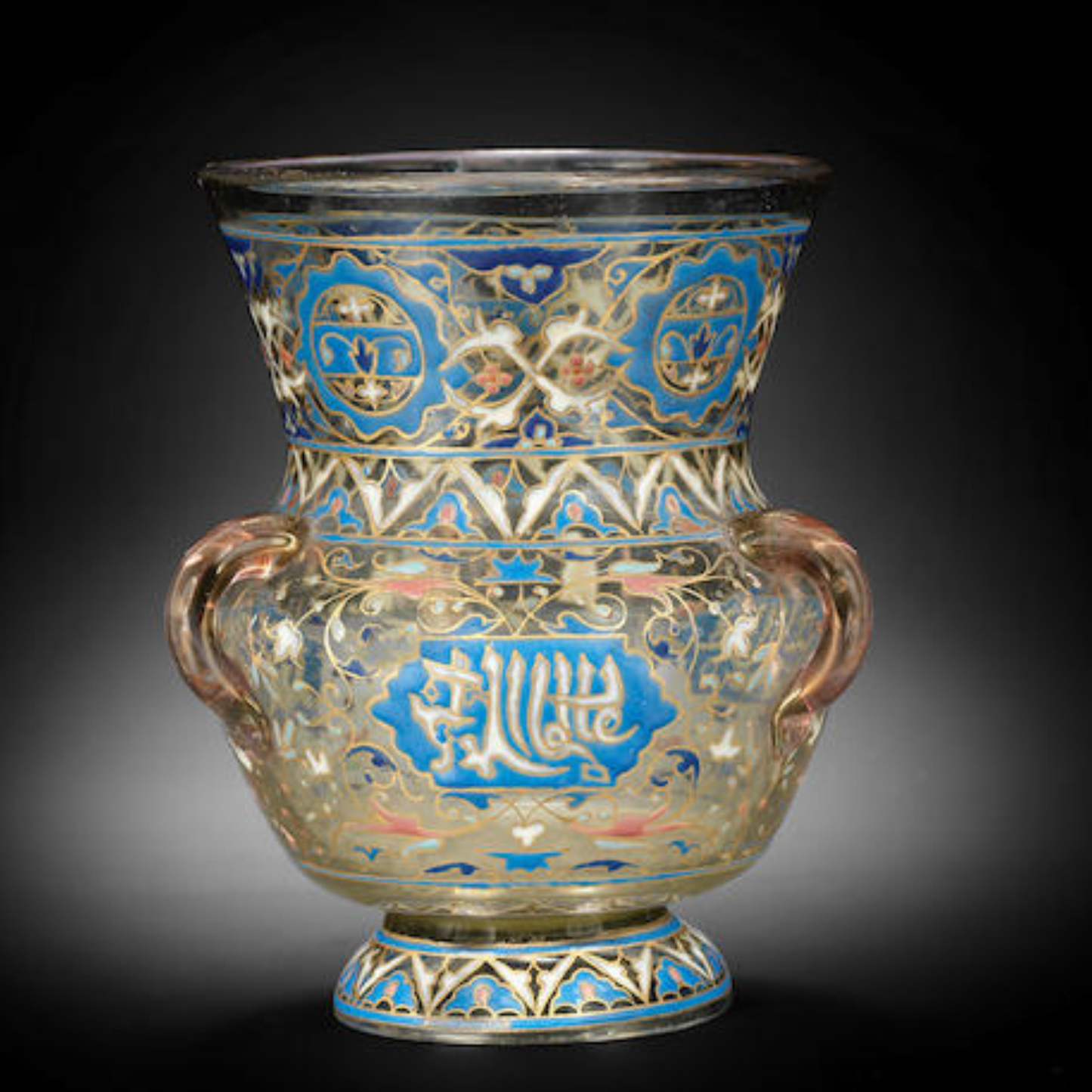
Small globular footed vase with a tall flared neck, featuring three small handles on the belly, made of translucent smoked amber blown glass. The three handles, made of pink translucent glass, are hot-applied. The surface is entirely covered with a rich polychrome enameled decoration, enlivened with metallic effects and gilded highlights.
In its silhouette, this vase is inspired by Mamluk "mosque lamps", whose forms were widely reinterpreted by 19th-century French glassmakers in the context of the taste for Orientalism. The three small handles punctuating the belly, in particular, may evoke, by their arrangement, the characteristic suspension rings of these lamps.
The enameled decoration covers the entire foot, belly, and neck. It consists of geometric motifs, stylized floral and vegetal motifs, treated in an Oriental-inspired ornamental vocabulary and interrupted by medallions and cartouches with complex outlines, hosting a pseudo-calligraphy.
Auguste Jean was not the only glassmaker to be inspired by Mamluk mosque lamps: Émile Gallé and especially Philippe-Joseph Brocard also offered reinterpretations. Unlike Brocard, who sometimes verged on pastiche, Auguste Jean's historical reference was, however, subject to a particularly free reinterpretation. With its height of 15.8 cm, its compact proportions, and its small size, the vase deviates significantly from historical models. The use of pseudo-calligraphy, devoid of meaning, also contributes to this evocation of a dreamed Orient rather than a desire to faithfully reproduce an ancient model. The work thus testifies to this largely fantasized conception of the Orient that fueled the imagination of artists and French decorative arts in the 19th century.
This form remains rare in Auguste Jean's known work. Only one other example has currently been identified. Its decoration, however, this time draws from an East Asian vocabulary, demonstrating Auguste Jean's ability to apply the same structure to different sources of inspiration.
Condition: Good condition. Some traces of restoration.
Signature: Signed on the reverse, under the base, in red-orange enamel: "A. Jean".
Partager