Auguste Jean
PAIR OF BUSTS DEPICTING THE SEASONS
PAIR OF BUSTS DEPICTING THE SEASONS
Circa 1860
Polychrome glazed earthenware
L. 60 cm; W. 24 cm; D. 1.4 cm
Private collection
© Aguttes, Paris
_
Aguttes, Arts Décoratifs du XXème, Lot 405 (estimate €1,500–2,000), Paris, 18 November 2011.
_
Large rectangular plaque in glazed earthenware with polychrome decoration on a blue ground. Within a central oval cartouche are three cherubs accompanied by a dog, carrying arrows and a hunting horn, set within a wooded landscape. The cartouche is framed by scrolling foliage, among which two birds are perched.
This work brings together the principal stylistic characteristics of Auguste Jean: a highly harmonious composition, finely executed glazed decoration, a taste for detail, rich polychromy, his characteristic blue ground, and an iconography directly inspired by Italian maiolica.
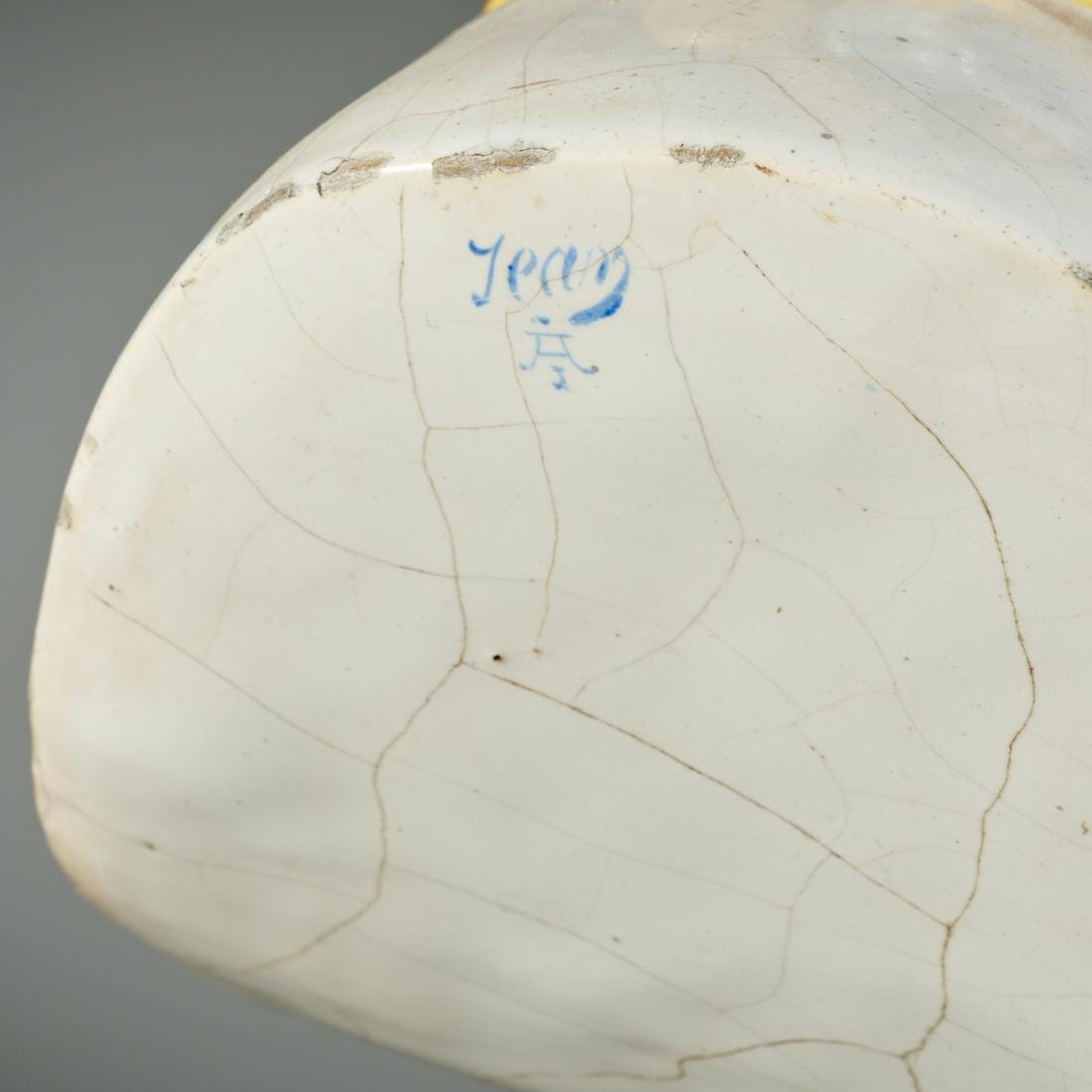
The plaque's original intended purpose remains unknown. Signed “Jean AJ” at lower right, it bears on the reverse the mark of the Pichenot / J. Loebnitz firm, a manufacturer of earthenware from whom Auguste Jean obtained earthenware supports and objects that he subsequently embellished with painted enamel decoration, before establishing his own manufacturing workshop from 1863 onwards. This mark, also recorded on several other works signed by the artist, provides valuable evidence for dating and makes it possible to place this work around the 1860s.
pareil pour cette notice : "Entre 1859 - 1884
Faïence émaillée polychrome
D. 22 cm
Collection privée
© Nicolas Roblin (Arts Elysion)
_
Vendu par Nicolas Roblin (via Arts Elysion).
_
Très bel encrier et sa soucoupe reposant sur quatre petits pieds coniques en faïence émaillée à décor de rinceaux feuillagés et chimères affrontées sur fond bleu.
Cette œuvre réunit les principaux traits stylistiques d'Auguste Jean : une composition d'une grande harmonie, la finesse du décor émaillé, le goût du détail, la richesse de la polychromie, ainsi que son célèbre fond bleu.
Bien que destiné à un usage quotidien, cet encrier est exécuté avec le même soin que les œuvres les plus ambitieuses d'Auguste Jean, dont la production couvre aussi bien les torchères et luminaires, fontaines monumentales, bustes, vases et coupes, vasques et jardinières, pendules et carreaux de revêtement pour cheminées ou salles de bains que les objets utilitaires."
Bien sûr. Je conserverais le même niveau de langage que pour la précédente, en privilégiant une formulation de notice d’œuvre destinée à un public international de musées, collectionneurs et spécialistes.
Between 1859 and 1884
Polychrome glazed earthenware
D. 22 cm
Private collection
© Nicolas Roblin (Arts Elysion)
_
Sold by Nicolas Roblin (via Arts Elysion).
_
Very fine inkwell and saucer, resting on four small conical feet, in glazed earthenware decorated with scrolling foliage and confronted chimeras on a blue ground.
This work brings together the principal stylistic characteristics of Auguste Jean: a highly harmonious composition, finely executed glazed decoration, a taste for detail, rich polychromy, as well as his characteristic blue ground.
Although intended for everyday use, this inkwell is executed with the same care as Auguste Jean's most ambitious works. His production encompassed torchères and lighting fixtures, monumental fountains, busts, vases and bowls, basins and jardinieres, clocks, and tiles for fireplaces or bathrooms, as well as utilitarian objects.
pareil pour cette notice : "Vers 1865
Faïence émaillée polychrome
H.80 cm ; l.48 cm ; P.28 cm
Collection privée
© Millea Bros Ltd
_
Avant 2021 : Collection privée, à King's Point (New York - USA).
Millea Bros Ltd à Boston (USA) via LiveAuctioneers, lot 3251 (estimé 5000 - 7000 dollars), mai 2021.
La paire est visible dans la saison 2 de la série américaine The Gilded Age, tournée en 2022.
Vendu en 2023 par un antiquaire à New York via Chairish.
_
Paire de bustes féminins en faïence émaillée polychrome, représentant vraisemblablement les allégories de *l'Été *et de l'Automne. Coiffées respectivement d'une couronne d'épis de blé et de grappes de raisin, les deux figures idéalisées, vêtues à l'antique, présentent des carnations blanches, contrastant avec la richesse des émaux qui animent les chevelures, les bijoux et les draperies. Elles reposent sur des socles piédouches démontables revêtus d'une couverte bleu profond, caractéristique d'Auguste Jean.
Datés des environs de 1865, époque où plusieurs bustes de l'artiste sont mentionnés dans les catalogues d'exposition et dans la presse, ces deux modèles témoignent de la maîtrise d'Auguste Jean dans l'art de la peinture sur émail. La qualité du modelé laisse supposer l'intervention d'un sculpteur, dont l'identité demeure inconnue, tandis que le décor peint révèle tout le talent du peintre-céramiste.
Par leur iconographie comme par leur traitement décoratif, ces œuvres s'inscrivent dans le goût néo-Renaissance qui s'épanouit sous le Second Empire. Elles renouent avec la tradition des grands bustes allégoriques du XVIIIᵉ siècle qui puisent leur inspiration dans la Renaissance italienne, et trouvent un écho dans les productions contemporaines de Giuseppe Devers, Edme Samson, de la manufacture Barbizet ou encore d'Albert-Ernest Carrier-Belleuse. Elles illustrent une facette encore méconnue de l'œuvre d'Auguste Jean et comptent parmi les premiers exemples du renouveau de la sculpture céramique polychrome en France.
À ce jour, seuls quatre bustes d'Auguste Jean sont identifiés : cette paire, le monumental Printemps, récemment entré dans les collections du musée d'Orsay, et la Tête de jeune fille, offerte par l'artiste à Adrien Dubouché en 1867 et aujourd'hui conservée au musée national Adrien-Dubouché de Limoges."
Voici la traduction en conservant le ton de notice de catalogue et la terminologie spécialisée utilisée précédemment :
Circa 1865
Polychrome glazed earthenware
H. 80 cm; W. 48 cm; D. 28 cm
Private collection
© Millea Bros Ltd
_
Prior to 2021: Private collection, King's Point, New York, USA.
Millea Bros Ltd, Boston, USA, via LiveAuctioneers, Lot 3251 (estimate $5,000–7,000), May 2021.
The pair can be seen in Season 2 of the American television series The Gilded Age, filmed in 2022.
Sold in 2023 by an antiques dealer in New York via Chairish.
_
Pair of female busts in polychrome glazed earthenware, probably representing the allegories of Summer and Autumn. Wearing respectively crowns of wheat ears and clusters of grapes, the two idealized figures, dressed in the antique style, have white complexions contrasting with the richness of the enamels enlivening their hair, jewelry, and draperies. They rest on removable socle bases covered in a deep blue glaze, characteristic of Auguste Jean.
Dating from around 1865, a period when several busts by the artist are mentioned in exhibition catalogues and the press, these two models testify to Auguste Jean's mastery of the art of enamel painting. The quality of the modelling suggests the involvement of a sculptor whose identity remains unknown, while the painted decoration reveals the full talent of the painter-ceramist.
In both their iconography and decorative treatment, these works reflect the Neo-Renaissance taste that flourished during the Second Empire. They revive the tradition of large allegorical busts of the eighteenth century, drawing their inspiration from the Italian Renaissance, and find echoes in contemporary works by Giuseppe Devers, Edme Samson, the Barbizet manufactory, and Albert-Ernest Carrier-Belleuse. They illustrate a still little-known aspect of Auguste Jean's work and rank among the earliest examples of the revival of polychrome ceramic sculpture in France.
To date, only four busts by Auguste Jean have been identified: this pair, the monumental Spring, recently acquired by the Musée d'Orsay, and the Head of a Young Girl, presented by the artist to Adrien Dubouché in 1867 and now held in the collections of the Musée national Adrien-Dubouché in Limoges.
Condition: Good condition
Signature: Signed "Jean AJ" on the shoulders and bases.
Partager